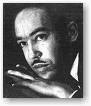
Bird in Orbit from Hughes’ “Ask Your Mamma”
p. 515 – 519
references:
“Eartha”
Eartha Mae Kitt, born January 17, 1927, is an actress and singer.
She was born illegitimate in South Carolina, but jokes about the fact that many audiences assume her to be from somewhere more exotic. Her hits include "Let's Do It," "An Old-Fashioned Millionaire" and "Santa Baby."
Eartha Kitt made her film debut in 1958, and was once described by Orson Welles as "the most exciting girl in the world". In the Batman television series of the 1960s, she played "Catwoman" in succession to Julie Newmar.
Bo Diddley
Bo Diddley (born December 30, 1928), "The Originator", is an influential American blues singer, songwriter, and guitarist. He was born Ellas Bates and later took the name Ellas McDaniel, after his adoptive mother, Gussie McDaniel. He adopted the stage name Bo Diddley, which is probably a southern black slang phrase meaning "nothing at all", as in "he ain't bo diddley". Another source says it was his nickname as a Golden Gloves boxer.
He was given a guitar by his sister as a youth, but also took violin lessons. He was inspired to become a blues artist by seeing John Lee Hooker.
He is best known for the "Bo Diddley beat", a rhumba-based beat (see clave) also influenced by what is known as "hambone", a style used by street performers who play out the beat by slapping and patting their arms, legs, chest, and cheeks while chanting rhymes. The Bo Diddley beat is often illustrated with the phrase: "shave 'n' a haircut - two bits".
Rhythm is so important in Bo Diddley's music that harmony is often reduced to a bare minimum. His songs (for example "Hey Bo Diddley" and "Who Do You Love?") often have no chord changes; that is, they are not written in a musical key, and the musicians play and sing in the same chord throughout the piece.
His own songs have been frequently covered. The Animals recorded "The Story of Bo Diddley", The Yardbirds covered "I'm a Man", and both the Woolies and George Thorogood had hits with "Who Do You Love", also a concert favorite of The Doors. His "Road Runner", one of his two Top 40 hits, was also frequently covered. ("Say Man" was the other Top 40 hit.)
Bo Diddley used a variety of rhythms, however, from straight back beat to pop ballad style, frequently with maracas by Jerome Green. He was also an influential guitar player, with many special effects and other innovations in tone and attack. He also plays the violin and cello; the latter is featured on his mournful instrumental "The Clock Strikes Twelve".
His lyrics are often witty and humorous adaptations of folk music themes. His first hit, "Bo Diddley" was based on the lullaby "Mockingbird". Likewise, "Hey Bo Diddley" is based on the folk song, "Frog went a-courtin'". The rap-style boasting of "Who do you love?", a word play on hoodoo, used many striking lyrics from the African-American tradition of toasts and boasts. His two versions of "Say Man" have been connected with rap, but actually feature the insults known as the Dirty Dozens: "You look like you been in a hatchet fight and everybody had a hatchet except you."
Lil Greenwood:
Lil Greenwood might be most well known as a vocalist with Duke Ellington's band for a few years starting in the late 1950s. She is featured on Ellington's album My People, but her career as a recording artist in her own right was highlighted by more RB-oriented sides she did in the early 1950s for Modern and Federal. Though she didn't have hits, Greenwood was one of many California-based singers in these years recording in a style intersecting jazz with blues and a bit of gospel.
Harry Belafonte:
Belafonte was born in Harlem in New York City. Overwhelmed and intimidated by its ghetto streets and thinking the islands to be a safer place, his immigrant mother sent him back to the island of her birth, Jamaica, the island and all its variety became a cultural reservoir which he drew upon for his artistic expression.
At the outbreak of World War II, his mother retrieved him from the island and brought him back to Harlem. He tried to adapt to his new environment, a process which came with great difficulty and finally, unable to finish high school, he enlisted in the United States Navy. After his tour of duty was over and he was honorably discharged, he returned to New York where he worked both in the garment center and as a janitor’s assistant.
It wasn’t until Belafonte was given two free tickets to a production of “Home is the Hunter” at the American Negro Theatre (A.N.T.) that the world of theater opened up to him. As Belafonte describes it, “It was like walking into a sanctuary, it was a deeply moving spiritual experience.”
Inspired by what he saw on stage and deeply touched by the sense of community displayed by the actors, Belafonte, for the first time, came face to face with what would be his destiny – a life in performing arts.
Although he found the environment most seductive, his appreciation of all facets of the theater did not, at first, help him settle on what he specifically wanted to do.
It wasn’t until he was called upon to play the role of young Johnny Boyle in the A.N.T. production of Irish playwright Sean O’Casey’s “Juno and the Paycock,” that Belafonte found focus. Inspired by the power of O’Casey’s writing,, Belafonte knew unequivocally that acting would be his first choice.
He then joined the Dramatic Workshop of the School of the School of Social Research under the tutelage of the great German director, Erwin Piscator, and with classmates like Marlon Brando, Walter Matthau, Bea Arthur, Rod Steiger and Tony Curtis – just to name a few – Belafonte became thoroughly grounded in the world of performing arts.
In pursuit of study at the school, Belafonte was subsidized by the U.S. government (The G.I. Bill of Rights). As many ex-servicemen were to experience, the subsidy ran out all too soon. In his quest to continue his student work in theater, his new-found friend, Monte Kaye, the revered and highly respected promoter for the Royal Roost, came to his rescue.
Having heard Belafonte sing at the Workshop in the student production, Kaye suggested that if Belafonte could learn three or four songs, he would hire him as the intermission singer at famed jazz club. To help him learn the songs, Kaye made available a young jazz pianist named Al Hage who was joined on Belafonte’s opening night at the Royal Roost by a host of friends who volunteered to be his back-up band. Although the audience may have had some curiosity as to who Belafonte was, they were most familiar with his “back-up band” – Charlie Parker, Miles Davis, Max Roach and Tommy Potter.
The warmth and camaraderie emanating from the “back-up band” helped a frightened and unsure Belafonte launch what was to be the first step to a career that has since been globally embraced.
The recognition of his gift was instant, but Belafonte soon found himself overwhelmed by this newfound popularity which was pulling him surely but slowly away from the world of theater he had come to love. Feeling the intervention of this new career most distracting from his acting interests, Belafonte soon retired to devote himself full-time to the theater.
He soon found that America was as yet unwilling to embrace its black citizens fully in his chosen profession, and with not enough parts to go around for the many talented actors, including his close friend, Sidney Poitier, Belafonte, in frustration, opened a small eatery in Greenwich Village as a means of livelihood.
He would have languished there had he not discovered a small night club called The Village Vanguard and the world of folk music. Watching artists like Lead Belly, Woody Guthrie, Josh White, Pete Seeger and others, Belafonte found an art form that would become his ultimate expression.
Josephine Baker:
Josephine Baker grew up in St. Louis, Missouri, but left home at an early age and began performing on stage. She appeared in the chorus lines of all-black revues on vaudeville, and travelled to Paris in 1925 as part of La Revue Negre. Her lithe body and clowning around on stage caused a sensation, and by the 1930s she was so successful she had her own nightclub. Baker was famous for her exotic outfits and uninhibited sexuality, her trademarks being a leopard on a leash, a skirt made of feathers and a dance in which she wore bananas on her head and not much else. In 1937 she became a citizen of France, and during World War II she worked with the Resistance against the Nazis. After the war she fought for civil rights in the United States, returned to France and retired in 1956 to look after her 12 adopted children. In the late '60s Baker was rescued from destitution by Princess Grace, who helped Baker put on another stage show, Josephine. She died in 1975 and was given a state funeral in Paris.
Negritude: noun: an ideological position that holds Black culture to be independent and valid on its own terms
Aime Cesaire demolishes the old maxim that poets make terrible politicians. Known in the world of letters as the progenitor of Negritude (the first diasporic "black pride" movement), a major voice of Surrealism, and one of the great French poets, Césaire is also revered for his role in modern anticolonial and Pan-African movements. While it might appear that the poet and politician operated in separate spheres, Césaire's life and work demonstrate that poetry can be the motor of political imagination, a potent weapon in any movement that claims freedom as its primary goal.
Born on June 25, 1913, in the small town of Basse-Pointe, Martinique, Césaire and his five siblings were raised by their mother, who was a dressmaker, and their father, who held a post as the local tax inspector. Although their father was well-educated and they shared the cultural sensibilities of the petite bourgeoisie, the Césaires nonetheless lived close to the edge of rural poverty. Aimé turned out to be a brilliant, precocious student and at age 11 was admitted to the Lycée Schoelcher in Fort-de-France. Upon graduation in 1931, he moved to Paris and enrolled in the Lycée Louis-le-Grand to prepare for the grueling entrance exams to the École Normale Supérieure (a high-level teachers' training college). There he met a number of like-minded intellectuals, most notably the Senegalese intellectual Léopold Sédar Senghor. Among other things, they began to study African history and culture, particularly the writings of German ethnologist Leo Frobenius, whose The Voice of Africa provided a powerful defense of Africa's cultural and intellectual contributions to the world.
The twosome, along with Césaire's childhood friend, poet Léon-Gontran Damas, launched a journal called L'Étudiant Noir (The Black Student). In its March 1935 issue, Césaire published a passionate tract against assimilation in which he first coined the term "Negritude." It is more than ironic that at the moment Césaire's piece appeared, he was hard at work absorbing as much knowledge about French and European humanities as possible in preparation for his entrance exams for École Normale Supérieure. The exams took their toll, for sure, though the psychic and emotional costs of having to imbibe the very culture Césaire publicly rejected must have exacerbated an already exhausting regimen.
After completing his exams during the summer of 1935, he took a short vacation to Yugoslavia with a fellow student. While visiting the Adriatic coast, Césaire was overcome with memories of home after seeing a small island from a distance. Moved, he stayed up half the night working on a long poem about the Martinique of his youth—the land, the people, the majesty of the place. The next morning when he inquired about the little island, he was told it was called Martinska. A magical chance encounter, to say the least; the words he penned that moonlit night were the beginnings of what would subsequently become his most famous poem of all: "Cahier d'un Retour au Pays Natal (Notebook of a Return to My Native Land)".
Charlie Parker • Saxophonist / Bandleader / Jazz Musician
Name at birth: Charles Christopher Parker, Jr.
Parker, nicknamed "Yardbird" ("Bird" for short), had an undistinguished early career, but ended up being one of the creators of bebop jazz in the 1940s. He played with artists such as Dizzy Gillespie and Miles Davis, all the while making his mark as an inventor of melodies and creative improviser. Highly influential and praised by fellow musicians, Parker had a brief career due to his troubled personal life and addictions to alcohol and heroin.
Extra credit: In 1988 jazz fan Clint Eastwood made a biographical movie about Parker, Bird, with Forest Whitaker in the title role.
John Jasper’s “Do-Move Cosmic Consciousness”
"De Sun Do Move"
Sermon by John Jasper (1812-1901)
[The following text is taken from John Jasper: The American Negro Preacher and Philospher by William E. Hatcher, published in 1908. Jasper gained national fame in 1878 when he first preached this sermon, which he later delivered by invitation more than 250 times, including once before the Virginia General Assembly. The text below is from Chapter XIII of Hatcher's book and the introduction is by the author. The image is courtesy of Sixth Mount Zion Baptist Church.]
In presenting John Jasper's celebrated sermon on "De Sun Do Move", I beg to introduce it with several explanatory words. It includes an extended discussion, after his peculiar fashion, of the text, "The Lord God is a man of war; the Lord is His name." Much that he said in that part of his sermon is omitted, only so much being retained as indicates his view of the rotation of the sun. It was really when he came into this part of his sermon that he showed to such great advantage, even though so manifestly in error as to the position which he tried so manfully to antagonize. It was of that combative type of public speech which always put him before the people at his best. I never heard this sermon but once, but I have been amply aided in reproducing it by an elaborate and altogether friendly report of the sermon published at the time by The Richmond Dispatch. Jasper opened his discourse with a tender reminiscence and quite an ingenious exordium.
"Low me ter say," he spoke with an outward com- posure which revealed an inward but mastered swell of emotion, "dat when I wuz a young man and a slave, I knowed nuthin' wuth talkin' 'bout consarnin' books. Dey wuz sealed mysteries ter me, but I tell yer I longed ter break de seal. I thusted fer de bread uv learnin'. When I seen books I ached ter git in ter um, fur I knowed dat dey had de stuff fer me, an' I wanted ter taste dere contents, but most of de time dey wuz bar'd aginst me.
"By de mursy of de Lord a thing happened. I got er room-feller-he wuz a slave, too, an' he had learn'd ter read. In de dead uv de night he giv me lessons outen de New York Spellin' Book. It wuz hard pullin', I tell yer; harder on him, fur he know'd jes' a leetle, an' it made him sweat ter try ter beat sumthin' inter my hard haid. It wuz wuss wid me. Up de hill ev'ry step, but when I got de light uv de less'n into my noodle I farly shouted, but I kno'd I wuz not a scholur. De consequens wuz I crep 'long mighty tejus, gittin' a crum here an' dar untel I cud read de Bible by skippin' de long words, tolerable well. Dat wuz de start uv my eddicashun-dat is, wat little I got. I mek menshun uv dat young man. De years hev fled erway sense den, but I ain't furgot my teachur, an' nevur shall. I thank mer Lord fur him, an' I carries his mem'ry in my heart.
"'Bout seben months after my gittin' ter readin', Gord converted my soul, an' I reckin 'bout de fust an' main thing dat I begged de Lord ter give me wuz de power ter und'stan' His Word. I ain' braggin', an' I hates self-praise, but I boun' ter speak de thankful word. I b'lieves in mer heart dat mer pra'r ter und'- stand de Scripshur wuz heard. Sence dat time I ain't keer'd 'bout nuthin' 'cept ter study an' preach de Word uv God.
"Not, my bruthrin, dat I'z de fool ter think I knows it all. Oh, mer Father, no! Fur frum it. I don' hardly und'stan myse'f, nor ha'f uv de things roun' me, an' dar is milyuns uv things in de Bible too deep fur Jasper, an'sum uv'em too deep fur ev'rybody. I doan't cerry de keys ter de Lord's closet, an' He ain' tell me ter peep in, an' ef I did I'm so stupid I wouldn't know it when I see it. No, frens, I knows my place at de feet uv my Marster, an' dar I stays.
"But I kin read de Bible and git de things whar lay on de top uv de soil. Out'n de Bible I knows nuthin' extry 'bout de sun. I sees 'is courses as he rides up dar so gran' an' mighty in de sky, but dar is heaps 'bout dat flamin' orb dat is too much fer me. I know dat de sun shines powerfly an' po's down its light in floods, an' yet dat is nuthin' compared wid de light dat flashes in my min' f rum de pages of Gord's book. But you knows all dat. I knows dat de sun burns oh, how it did burn in dem July days. I tell yer he cooked de skin on my back many er day when I wuz hoein' in de corn fiel'. But you knows all dat, an' yet dat is nuthin' der to de divine fire dat burns in der souls uv Gord's chil'n. Can't yer feel it, bruthrin? …
Showing posts with label Bird in Orbit. Show all posts
Showing posts with label Bird in Orbit. Show all posts